
Many people think of missed-connections as a product of the internet age, something born on Craigslist or popularized by sites like this one. But the impulse to reach back across time and space for someone you barely met is far older than any website or newspaper.
Antiquity — Before 79 AD
Long before print advertising existed, people found ways to broadcast their feelings to the world. In ancient Rome, the walls of Pompeii were covered in personal declarations of desire, attraction, and longing — scratched directly into stone and plaster, preserved for nearly two thousand years by the eruption of Vesuvius in 79 AD. One inscription, catalogued in the Corpus Inscriptionum Latinarum, sets the tone for public declarations of love:
"Qui amat valeat, pereat qui nescit amare, bis tanto pereat, quisquis amare vetat."
"Let whoever loves be well, let whoever knows not how to love perish. Twice as much, let whoever forbids love perish."
17th & 18th Century England
The rise of newspapers in the 17th century created an entirely new way for people to reach strangers — and people wasted no time using it. One of the earliest known personal advertisements appeared in the British publication The Athenian Mercury in 1695, widely considered the first personal ad in history:
"A Gentleman about 30 Years of Age, that says he has a very good Estate, would willingly match himself to some Good Young Gentlewoman, that has a Fortune of £3,000 or thereabouts, and can give good Security, that he has no Incumbrances, and will make a Settlement to the Value of her Fortune. If this please, for further Particulars, let her by a Line directed to A.B.C. at Mr. John Smith's, a Bookseller, in Lombard-street."
Matrimonial notices gave way, over the following decades, to something more immediate. By 1748, classified advertisements were appearing that described specific encounters — a particular person, seen on a particular day, in a particular place — written by someone who had not spoken to them and simply hoped they would read the paper. These early ads were treated with a mixture of fascination and scandal. Editors debated whether to print them. Police sometimes monitored them. And yet readers loved them — and they kept coming.
Victorian Era — 1800s
The 19th century was a golden age for the printed personal ad. As literacy spread and newspapers became affordable, the "agony column" — a fixture of major London papers — became a beloved institution. Messages were written in deliberately vague or coded language to preserve decorum, with just enough detail to reach the one person who needed to read it.
Across the Atlantic, the New York Herald's "Personal" column ran daily — and its entries are almost indistinguishable from posts you might read on this site today:
"YOUNG LADY, who wears a blue veil, seen at Broadway omnibus, Tuesday last, at four o'clock — The gentleman in gray suit, who offered his seat, is anxious to continue the acquaintance. Address J.M., Herald office."
"IF THE LADY who picked up a pocket handkerchief in Union Square, near Fourteenth street, on Thursday afternoon, will address C.L., box 4, Herald office, she will oblige a gentleman who wishes to return the compliment."
British pubs informally hosted bulletin boards where cryptic notes could be pinned for someone seen across the bar. In the American West, cowboys left handwritten notes at hitching posts hoping a woman encountered on the trail might pass the same way again. By the close of the 19th century, what we now call a missed connection was a recognized and practiced form of communication on both sides of the Atlantic — even if no one had named it yet.
"I Saw You" — The Alt-Weekly Era
Since the 1950s the urban alternative weekly newspaper became the home of the modern missed connection. Independent, counterculture papers began appearing in American cities in the 1950s and 1960s and quickly became the beating heart of urban creative life and paved the way for the modern missed-connection.
The Village Voice, founded in New York City in 1955, led the way. Its classified section gave options for people who couldn't or wouldn't advertise in the mainstream press — LGBTQ+ readers, artists, bohemians, and romantics of every kind. It was here that the missed connection took its most recognizable modern shape: a brief note describing a person, a place, and a moment — addressed to no one and everyone at once.
A typical "I Saw You" ad from the era:
"WEST 4TH STATION, Tuesday, 6pm. You: dark coat, reading Neruda, smiled when the lights went out. Me: too stunned to speak. Coffee is the least I owe you. Box 2217."
The idea quickly spread to alt-weeklies in cities across the country, usually under the name "I Saw You" or "I Saw U" — a phrase that became so immediately understood it needed no further explanation. Among the publications that carried the column at the height of its popularity:
United States
- The Village Voice — New York, NY
- The Stranger — Seattle, WA
- Seattle Weekly — Seattle, WA
- Chicago Reader — Chicago, IL
- LA Weekly — Los Angeles, CA
- SF Weekly — San Francisco, CA
- Boston Phoenix — Boston, MA
- Denver Westword — Denver, CO
- Portland Mercury — Portland, OR
- Nashville Scene — Nashville, TN
Canada
- The Georgia Straight — Vancouver, BC
- NOW Magazine — Toronto, ON
- Montreal Mirror — Montreal, QC
United Kingdom
- Time Out London — London, England
- Metro — National UK (as "Rush Hour Crush")
Australia
- MX Newspaper — Sydney & Melbourne (as "Here's Looking at You")
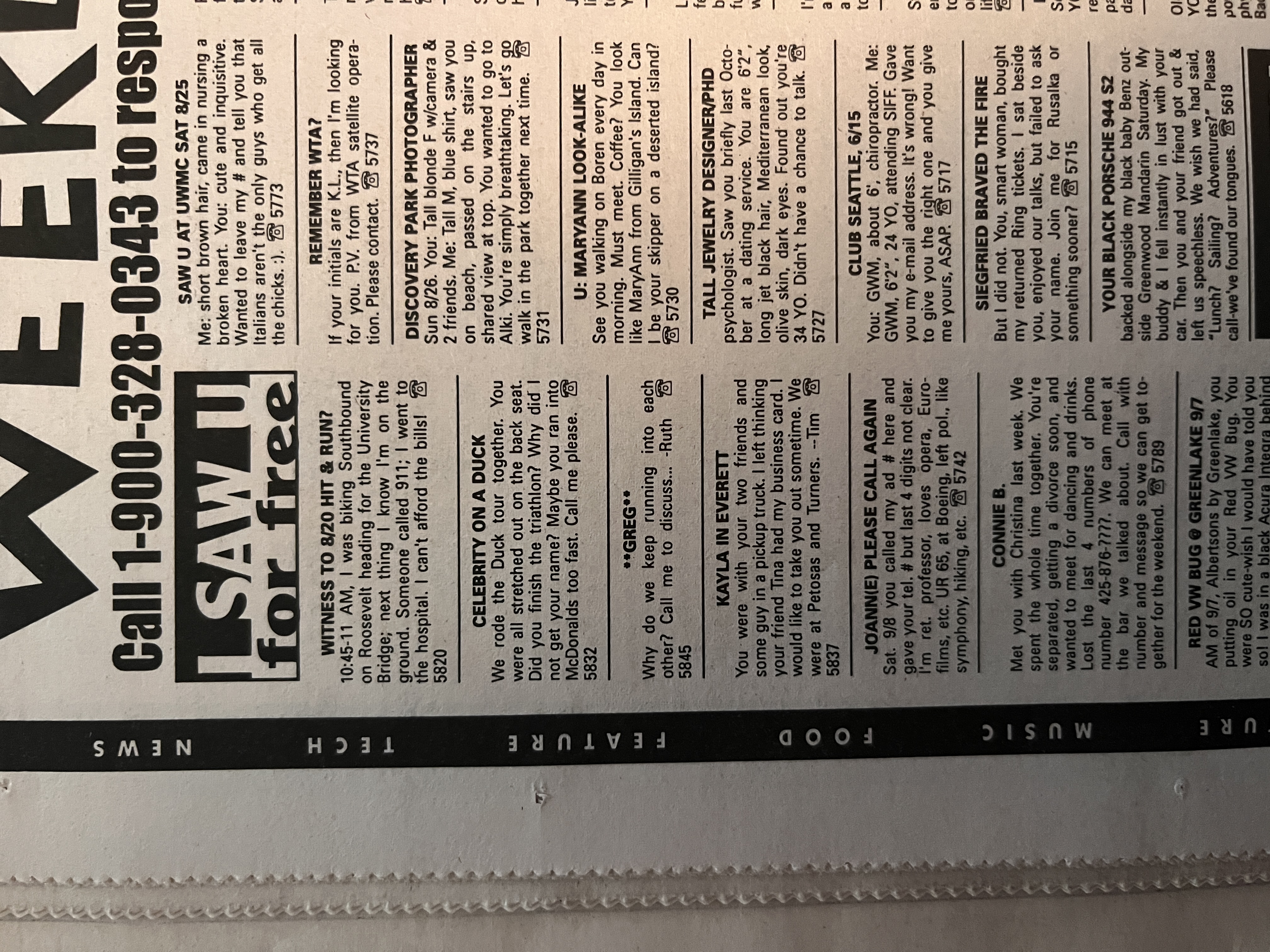
The Stranger's "I Saw U" column became so woven into Seattle's cultural fabric that readers demanded its return every time it went on hiatus. It runs there still. It was from this tradition — decades of newspaper columns built on those three quiet words — that iSawYou.com took its name.
From Print to Pixels — 1999 to the Present
By the late 1990s, the internet had arrived, and with it the possibility of reaching more people, more quickly, than any newspaper column ever could. The medium was new but the impulse was the same.
In 1999, iSawYou.com brought the first digital missed connections online and was the first website dedicated entirely to the format. What had lived for three centuries in stone, ink, and newsprint now had a permanent digital home.
Shortly after, Craigslist introduced its own Missed Connections section, which quickly became one of the most widely read corners of the internet — inspiring books, films, radio segments, and no small amount of genuine reunion. In the UK, the Metro newspaper launched Rush Hour Crush, a print-based column for the daily commuter, proof that the feeling still translated beautifully to ink even in the internet age.
Then, in 2018, the landscape shifted dramatically. The passage of U.S. FOSTA-SESTA legislation forced Craigslist to shutter its entire Personals section overnight. Other platforms quietly followed. One by one, the places that had held space for this very human impulse went dark. The field narrowed to almost nothing.
From "Missed Connection" to "Sighting"
There is something in the term — missed connection — that has always felt slightly defeated. It implies a loss. A gap that couldn't be closed. A door that swung shut before you reached it. We never liked that framing.
When iSawYou.com was built, we chose a different word: sighting. Not a loss — an event. Not a failure — a hopeful beginning. A sighting is something that happened, something real and vivid and worth remembering, regardless of what comes next. It puts the emphasis not on what you missed, but on what you saw.
The distinction matters more than it might seem. It shifts the entire event from regret to possibility and possibility is exactly the point.
When so much of how we meet people has been handed over to algorithms, compatibility scores and carefully curated profiles — a sighting is something wilder and rarer and more honest than any of that. It's about two people, in the same place, at the same time, with no mutual friends and no shared context and no reason to ever cross paths again. And yet something was seen and felt between them and that sets the stage for a much more valuable start to a relationship than swiping through profile pics.
The mantle passed to isawyou.com
What began in the graffiti of Pompeii, passed through the agony columns of Victorian London, crossed the Atlantic in the personal notices of the New York Herald, took root in the counterculture of the Village Voice and the columns of a hundred alt-weekly newspapers — now has its modern home at iSawYou.
Every medium that carried this tradition before eventually fell silent. Newspapers folded. Alt-weeklies disappeared. Craigslist closed its personals. The format that has survived two thousand years of human history is still thriving and even growing into a global phenomenon.
It’s not because we are the best funded, or the largest, or the most recently launched — but because we’re focused and understand the language of missed connections better than anyone. We are the oldest dedicated sightings platform on the internet, founded in 1999 and still running.
The future of meeting people you saw isn't a swipe or algorithm. It is exactly what it has always been: one person, brave enough to say I saw you — and another person, somewhere, who has been hoping someone would.
So if you saw someone — on the train, across the coffee shop, at a stoplight — and something passed between you, this is the place to find them. iSawYou is the home of missed-connections on the internet.
 Sightings
